
The holidays bring plenty of good food, especially baked goods. Warm ovens that hold baking breads, pies or cookies induce long inhales of lovely smells followed by smiles of anticipation. Anyone who has baked things such as bread from ‘scratch’ knows the importance a small amount of yeast has in leavening the dough. The verb “leaven” means ‘to permeate and modify or transform something’. Yeast transforms the dough so that it will produce bread that is light and fluffy in texture. Without good fresh yeast, the dough fails to rise and the resulting bread is flat, dense, and tough to eat. When this happens to me, I end up generously sharing it with our family dog, who lately has been getting excited when she sees me with flour, measuring cups, and a mixing bowl. I don’t take it personally, her ancient and wild ancestors have passed on their instinct to spot an impending easy kill…even a baked one emerging from the oven…but I digress.
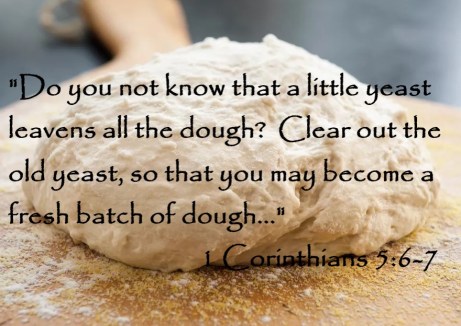
In the New Testament, there are several instances where yeast (‘leaven’) is used to teach us a lesson, mostly warnings about bad behavior. “Jesus said to them, ‘Look out, and beware of the leaven of the Pharisees and Sadducees‘.” (Matthew 16:6). In Luke 12:1, Jesus says to his disciples, “Beware of the leaven—that is, the hypocrisy—of the Pharisees”. However, Jesus compares heaven to yeast in a positive way. “The kingdom of heaven is like yeast that a woman took and mixed with three measures of wheat flour until the whole batch was leavened” (Matthew 13:33). The lesson is in realizing what influence the ‘yeast’ of our behavior, good or bad, has on others. As Saint Paul writes in his first letter to the church in Corinth, “Do you not know that a little yeast leavens all the dough? Clear out the old yeast, so that you may become a fresh batch of dough, inasmuch as you are unleavened.” (1 Corinthians 5:6-7). Within ourselves, small undesirable behaviors can lead to larger ones. Outside of ourselves, our undesirable behaviors can have a negative influence on those around us.
The welcoming of a new year brings resolve and hope to improve our lives. We try to begin anew as we attempt to leave behind the old yeast of bad behaviors and poor habits. Clearing out that old yeast as St. Paul instructs us in order to begin as a fresh batch of unleavened dough is indeed a challenge! It is not enough only to remove the old yeast and end our efforts with that. We must replace our old yeast with something better or we will not be changed. In baking, when flour and water are mixed together to create new unleavened dough, that dough inevitably becomes leavened by wild yeast (Interesting fact: modern Jewish dietary laws mandate unleavened dough must be baked within 18 minutes for the resulting bread to be considered unleavened). Similarly, if we simply remove old bad behaviors but replace them with nothing, the undesirable behaviors and their effects creep back into our lives. A stronger prayer life, reading and meditating on Holy Scripture, a more active sacramental life and simply being aware of and avoiding the ‘bad yeast’ around us are just a few of the ways we avoid the return of the old and undesirable yeast in our own life.
We control what type of yeast grows in our new dough of the new year. Will it be the same old undesirable yeast or will it be the new good yeast of the kingdom of heaven, of which Jesus spoke? Hopefully it is the new good yeast of the kingdom of heaven, which will leaven us and those who encounter us in the New Year of 2019!
 Someday Saint